Meteorafinance DLMM - Price bins and liquidity placement
- updatedMeteorafinance DLMM lets liquidity providers select a price range and distribute tokens across individual bins on Solana. DLMM means Dynamic Liquidity Market Maker. Each bin holds liquidity at a fixed exchange price, and swaps move between bins as available liquidity runs out. A position’s range determines which prices it covers; its distribution determines how much capital sits at each price. Fee settings and the pool’s function mode then govern fee collection, liquidity mining eligibility, and native limit-order support.
Which price bins can earn trading fees?
Liquidity earns trading fees in the bins that swaps actually use, in proportion to the position’s share there. A position can cover the active price while placing much of its capital elsewhere in the range. That unused liquidity waits for trading to reach its bins. Only one bin is active at a time, and swaps use its fixed price while enough output liquidity remains. A larger swap can consume that liquidity and continue through other bins at different prices. Zero price movement within a bin therefore does not promise one fixed execution price across the whole swap.
Pool accounts, bin arrays, and position shares
The pool account connects market-wide settings to shared bin liquidity, while each position records a particular owner’s participation.
Pool state
An
LbPair
stores the token mints, reserve vaults, active bin ID, bin step, fee parameters, and pool status. Those fields describe the same market for every position. A position’s chosen shape does not create a separate pool or alter the pool’s bin spacing.
Bin arrays
BinArray
accounts group 70 bins for storage. Individual bins track token amounts and liquidity shares at their assigned prices. This grouping organizes on-chain data; it does not require every liquidity provider to deposit across an entire array.
Position ownership
A
PositionV2
account records the owner, lower and upper bin IDs, and per-bin liquidity shares. It also tracks pending fees and eligible rewards. DLMM uses dedicated position accounts, while DAMM v2 represents position ownership with NFTs.
Bin step controls the price ladder
Bin step measures the percentage spacing between neighboring prices in basis points. Smaller steps place adjacent bins closer together, while larger steps spread the same bin count across a wider interval. A bin count alone therefore cannot describe a position’s coverage. With a configured step of
s
basis points, each upward bin multiplies the preceding price by
1 + s / 10,000
. That multiplier describes adjacent prices, not a token amount or trading fee. The DLMM program supports bin steps up to 400 basis points; actual pool settings determine the applicable spacing.
Spot, Curve, and Bid-Ask distribute the deposit
Spot, Curve, and Bid-Ask can cover the same selected range while placing different amounts of liquidity inside it.
Spot
Spot spreads liquidity uniformly across selected bins. Presets such as Spot-Concentrated and Spot-Wide change the covered range while retaining that distribution family. The chosen boundaries determine whether the position concentrates capital tightly or spreads it across more prices.
Curve
Curve assigns more liquidity around the middle of the selected range. It suits an expectation that trading will remain near the center, with less capital supporting prices farther away.
Bid-Ask
Bid-Ask places more liquidity toward the range edges. It supports strategies that expect movement away from central prices, including gradual entry or exit. Edge liquidity can remain unused until swaps reach those bins, so the shape alone does not establish fee income.
Matching price boundaries with different active exposure
In a hypothetical comparison, two positions in the same DLMM pool have equal deposit values and identical price boundaries. The active price starts near the range center, and trading remains in the central bins. One position uses Spot, while the other uses Curve.
Curve allocates a larger portion of its deposit to the central bins, while Spot retains uniform placement across the range. Under these assumptions, Curve puts more of the equal deposit where swaps occur. The positions cover the same prices, yet they supply different amounts to the trading area.
That conclusion applies only while trading stays near the center. Swaps toward the edges encounter a different allocation, and trading beyond either position’s boundaries leaves both inactive. The comparison establishes capital placement, while realized earnings also depend on competing liquidity and actual trading fees.
Single-sided deposits and changing token balances
Single-sided liquidity places one token into selected bins, allowing exposure to change as trading moves through those prices. In a base-and-quote orientation, quote liquidity below the current price can gradually acquire the base token during downward movement. Base liquidity above the current price can gradually convert into the quote token during upward movement. The chosen side and range determine the intended conversion direction. Ordinary LP liquidity continues to belong to a market-making position as its token composition changes. Subsequent swaps can change that asset mix again, so a single-sided deposit involves ongoing exposure to the pair.
Changing token prices can leave the LP position worth less than holding its original assets, a difference called impermanent loss. A gradual entry or exit strategy specifies the prices at which liquidity is available, without establishing a completion time.
Base fees and volatility-sensitive charges
The trading fee combines a configured base fee with a variable component when the pool enables volatility-sensitive fees. DLMM caps the combined trading fee at 10%. The base calculation uses the pool’s bin step and other fee parameters. A wider price increment alone does not reveal the fee that a particular pool charges.
Recent bin movement feeds the volatility calculation, so repeated or larger movements can raise the variable component. Quieter periods allow the reference to decay. If variable fee control is zero, that component is zero.
Higher fees increase the charge on eligible trades, without preventing losses from changes in the traded tokens’ prices. Pool volume, competing active liquidity, and fee settings jointly affect earnings. A position’s income therefore reflects both market activity and its share of the bins used.
InputOnly and OnlyY determine the fee token
InputOnly and OnlyY determine the token that carries trading fees, independently of the position’s selected liquidity distribution.
InputOnly
InputOnly charges the asset entering each swap: X when traders exchange X for Y, and Y in the reverse direction. LPs can consequently accumulate fee balances in either asset as trade direction changes.
OnlyY
OnlyY collects fees in token Y: from Y input on Y-to-X swaps, and from Y output on X-to-Y swaps. This mode concentrates the fee currency in Y, often the pool’s quote asset.
Fee currency and liquidity composition describe different balances. Collecting fees only in Y does not keep the underlying position entirely in Y. Swaps still exchange the position’s tokens, and changing a distribution does not independently change the pool’s collection mode.
Incentive eligibility follows the pool function mode
Liquidity Mining and Limit Order are separate pool function modes, so their additional features do not coexist in one configuration. Liquidity Mining pools support funded reward campaigns and reject native limit-order placement. Limit Order pools support bid-side or ask-side order liquidity and do not support liquidity mining rewards.
Within a reward-enabled pool, eligible active liquidity earns a share of rewards from funded campaigns. During v2 swaps, reward accounting can allocate elapsed rewards across crossed bins with liquidity, subject to a 15-bin split limit. When the active price stays outside a position’s range, that position earns no new rewards.
Native orders and ordinary LP positions can supply liquidity within a limit-order pool, with fees allocated by liquidity source. A native order account can cover up to 50 bins. It fills only as swaps consume its liquidity, so an order may remain unfilled or fill only partially. Dynamic Vaults can generate lending yield for eligible vault-backed legacy products. DLMM bin liquidity earns trading fees and applicable pool incentives without lending through Dynamic Vaults.
Can a DLMM position expand beyond its original range?
Yes, a DLMM Dynamic Position can expand or shrink its bin range without closing the account first. Its default layout stores 70 bins, with extra per-bin data available for wider ranges. A PositionV2 account supports a maximum position length of 1400 bins.
New allocation beyond the default layout is limited to 91 added bins per resize instruction. Shrinking removes empty bins from either end. These limits concern account data and instruction scope; actual deposits determine how much capital occupies the enlarged range.
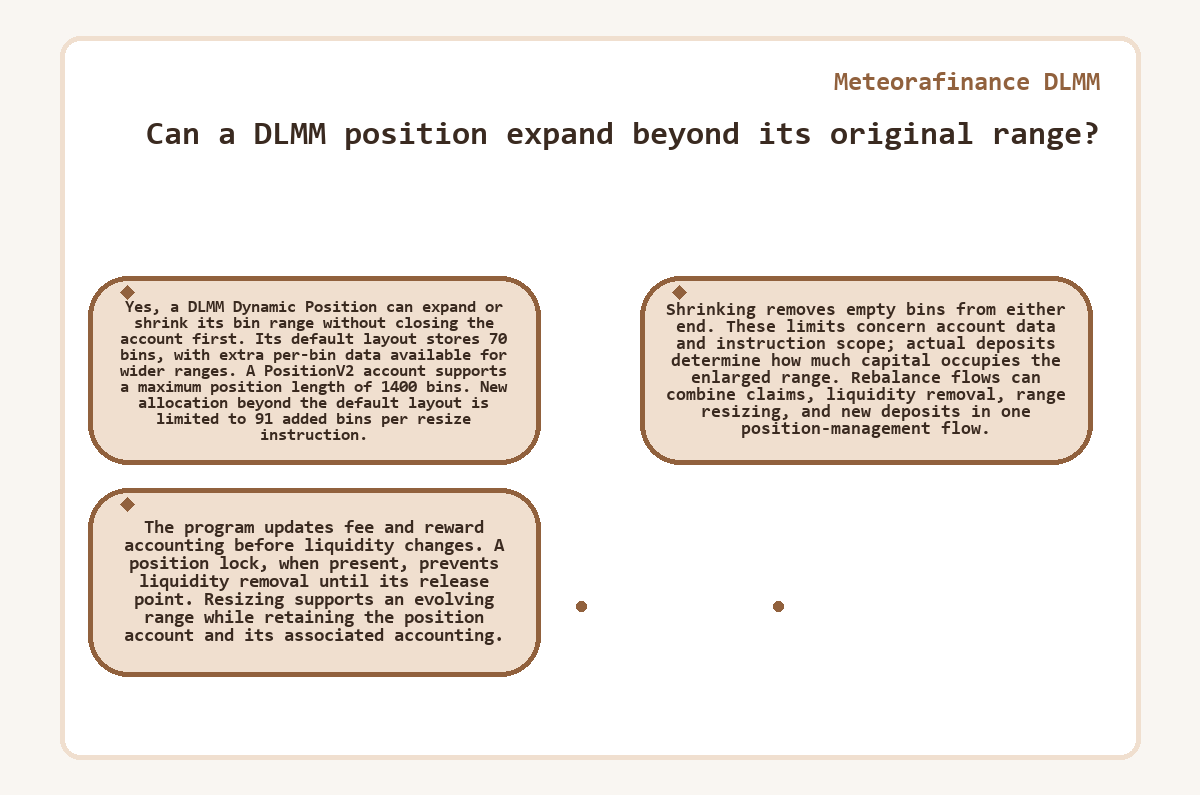
Rebalance flows can combine claims, liquidity removal, range resizing, and new deposits in one position-management flow. The program updates fee and reward accounting before liquidity changes. A position lock, when present, prevents liquidity removal until its release point. Resizing supports an evolving range while retaining the position account and its associated accounting.
Token support and launch activation set access conditions
Token 2022 compatibility follows each mint’s extensions and authorities, so the standard name alone does not establish permissionless support. DLMM accepts supported metadata and transfer-fee extensions through its permissionless path. TransferHook qualifies for permissionless support only when both the hook program and authority have been revoked. Sensitive extensions require token badge review. DLMM rejects the native Token 2022 mint; SOL liquidity uses standard wrapped SOL. A token’s transfer fee also creates a cost separate from the pool’s trading fee.
Launch configurations can add activation controls to the same bin-based market design. A connected Alpha Vault accepts participants’ quote deposits for purchases during the pool’s protected pre-activation window. The pool must whitelist that vault as its pre-activation buyer. The configured activation point governs public trading; the protected early purchase uses Alpha Vault.
Meteorafinance DLMM questions, answered
-
Does Meteorafinance DLMM automatically reinvest trading fees and rewards?
- DLMM fees and liquidity mining rewards remain claimable balances until claimed, without automatically compounding into position liquidity. Reinvesting requires an additional liquidity action.
-
How does DLMM rent differ between a position and a new bin array?
- Position rent funds an individual position account, while bin-array rent funds shared pool storage. Closing an eligible position can return its refundable rent. Creating previously unused bins can require a new bin array, whose creation rent is non-refundable. Wider position data can also require additional rent. The required SOL therefore follows the accounts that the selected range needs.
-
Who can manage a DLMM position after an operator receives permission?
- The position owner and an authorized operator can perform the position-management actions that the program permits, including liquidity changes. Some positions also specify a separate fee owner, and permission bits can allow particular actions, such as fee claiming, to become permissionless.
-
When can a DLMM position with no liquidity be closed?
- A DLMM position can close only after its liquidity, pending fees, and rewards have all been cleared. Removing deposited liquidity alone may leave claimable balances in the account.
-
Can a Token 2022 freeze authority prevent permissionless DLMM pool creation?
- A Token 2022 mint with a freeze authority requires additional review before DLMM acceptance. That authority can affect whether token accounts can transfer assets, which matters for deposits, swaps, and withdrawals. Token badge review addresses restricted mint behavior; the mint’s specific extensions and authorities determine the applicable support path.