Meteorafinance dynamic vaults tie LP withdrawals to unlocked value and available liquidity
- updatedMeteorafinance dynamic vaults calculate withdrawals from unlocked value and require available liquidity in the reserve or an approved strategy. Depositing the vault’s SPL token on Solana mints liquidity provider (LP) tokens. This legacy program supports rebalance vaults that deploy assets into strategies and idle vaults that keep assets in reserve.
Profit release changes the value available to vault shares, while reserve and strategy liquidity determine whether a withdrawal can complete.
Redeeming vault LP tokens when reserve liquidity changes
A withdrawal needs vault LP tokens and enough accessible underlying tokens to fund the redemption. The vault calculates the redeemable share from unlocked value, while the selected withdrawal path determines where those underlying tokens come from. Holding LP tokens establishes a share claim; the reserve balance determines whether a direct withdrawal can supply that claim.
A funded reserve and a reserve shortfall
For the same vault LP holding, the reserve can cover the calculated redemption or fall short. The target redemption starts from the same unlocked-value share calculation. Changing the reserve balance changes the withdrawal path and the liquidity that must become accessible.
- Identify the holding before selecting a withdrawal: vault LP tokens and DAMM v1 pool LP tokens represent different layers.
- If the calculated redemption meets your minimum output and the reserve can cover it, the direct withdrawal path can return the underlying token while burning vault LP tokens.
- If a rebalance vault has a reserve shortfall, its supported strategy-withdrawal path can pull funds from a listed strategy first.
- With the required accounts, a strategy-backed withdrawal may return less than requested and burn fewer LP tokens, subject to precision checks. Stop if neither path can meet your minimum output.
- Account for SOL transaction fees and any required account-creation rent. Completion means the underlying tokens transfer and the corresponding vault LP tokens burn.
Vault shares and DAMM v1 pool shares represent different holdings
A direct Dynamic Vault deposit produces shares in one underlying token. DAMM v1 adds another accounting layer: each token side of its pool points to a Dynamic Vault position. The pool values those vault holdings in underlying-token units when pricing swaps, issuing pool LP tokens, or calculating withdrawals.
The person holding DAMM v1 pool LP tokens owns a share of that two-token pool. Those pool tokens differ from the vault LP tokens that the pool holds underneath. Reading a vault balance as though it were the entire pool position would skip the AMM’s own share calculation and changing token composition.
DLMM uses separate position accounts and does not connect its trading liquidity to Dynamic Vault lending strategies.
Rebalance vaults and idle vaults use different liquidity locations
The program supports two vault types. Rebalance vaults can allocate assets to approved strategies, while idle vaults retain their assets in the reserve. Both use vault LP shares, so the presence of an LP-token balance does not identify whether any lending strategy is involved.
Liquidity that can fund withdrawals
Reserve balances
An idle vault holds all its underlying liquidity in the token reserve. A rebalance vault also has a reserve, although some of its assets may sit in strategy accounts. Direct withdrawal uses the reserve balance, so total recorded liquidity can exceed the amount sitting there.
Strategy balances
A rebalance vault can record up to 30 strategy accounts. Each entry identifies a strategy account; available lending integrations depend on the deployed program. Strategy deposits and withdrawals must use an account already listed on the vault. Idle vaults do not offer the rebalance vault’s strategy-management and operator configuration paths.
Why is some vault profit unavailable for withdrawal?
The vault adds reported strategy profit to locked profit and releases it over time before including it in unlocked value. A gain can therefore increase total recorded liquidity before the full gain contributes to a withdrawal calculation. The release behavior comes from vault configuration, so a fixed waiting period does not apply universally.
Withdrawals calculate the holder’s proportional share of the vault’s unlocked token value. The vault’s recorded total and its unlocked value can consequently differ while referring to the same underlying token. Profit release changes the accounting value available to shares; it does not move tokens out of a lending strategy.
When can a strategy cover a reserve shortfall?
A strategy can cover a shortfall when the rebalance vault has a listed, supported strategy with enough withdrawable liquidity. The separate user withdrawal path can pull assets from that strategy when the required accounts are supplied. If it returns less than requested, the program can reduce the LP burn, subject to minimum-output and precision checks. The connected lending market’s account state and available liquidity still govern what can leave.
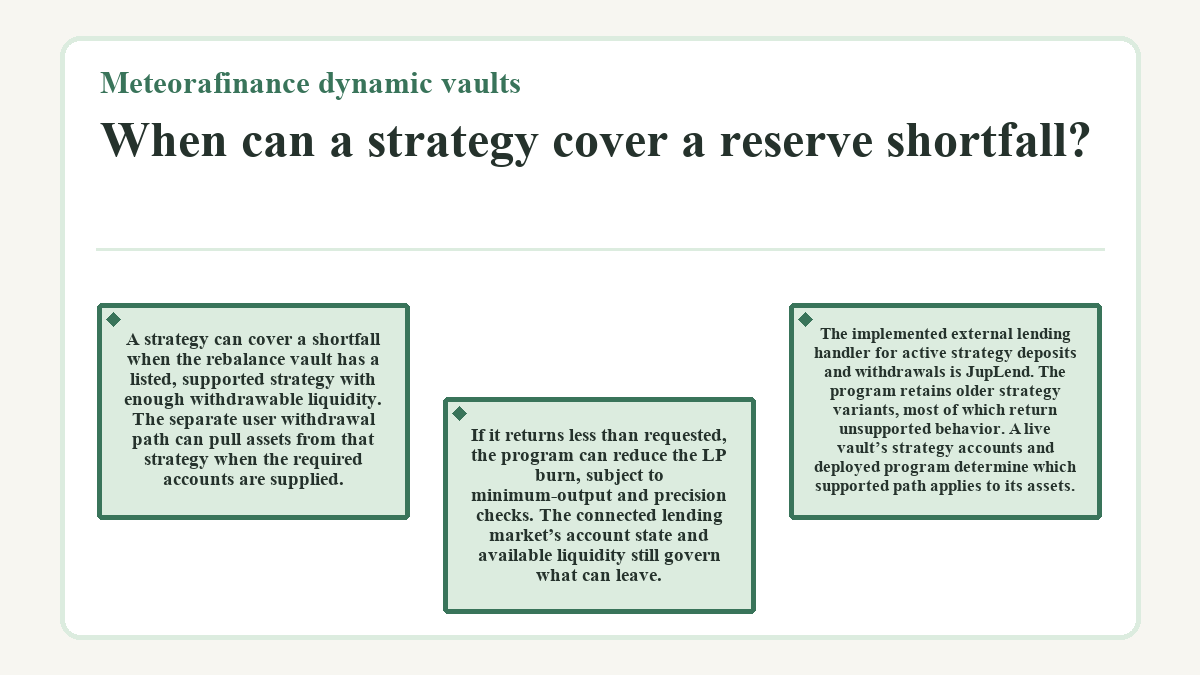
The implemented external lending handler for active strategy deposits and withdrawals is JupLend. The program retains older strategy variants, most of which return unsupported behavior. A live vault’s strategy accounts and deployed program determine which supported path applies to its assets.
Performance fees enter the calculation through LP supply
Profitable strategy actions can mint vault LP tokens to the configured fee vault. This fee mechanism changes the share supply without requiring a transfer of underlying tokens out of the reserve. Redemption value therefore reflects the relationship between unlocked underlying value and outstanding LP shares, including any shares that fee minting creates. The program calculates the performance fee as 5% of positive strategy gain. The minted LP tokens give the configured fee recipient a share of vault value.
How does Hermes affect access to strategy liquidity?
Hermes can submit approved strategy transactions through the configured operator role, while the vault program enforces account and accounting checks. Hermes is the off-chain operator layer historically used with Dynamic Vault. The vault admin can also submit supported strategy deposits and withdrawals.
For a strategy action, the listed strategy, reserve, collateral vault, and configured fee vault must satisfy the program’s account checks. An operator’s request cannot bypass those constraints. The vault then records the action’s gain or loss, updates total liquidity and locked profit, and handles applicable performance-fee minting.
Delayed rebalancing can leave assets in a less attractive strategy while program permissions continue to constrain operator actions.
Deposit limits and the cost of maintaining vault exposure
Disabling a rebalance vault stops deposits but does not block withdrawals. Deposits also fail when the calculated LP output falls below the depositor’s minimum. The minimum concerns the shares that the deposit would mint, so the submitted token amount alone does not establish whether the deposit meets it.
On Solana, on-chain actions require SOL for transaction fees, and creating required accounts can add rent costs. The account requirements of the selected action determine those costs. A performance fee that mints vault shares belongs to a different calculation from the SOL spent submitting a transaction.
Where a rebalance vault uses lending strategies, yield changes with market utilization, supported strategies, and operator timing. A strategy allocation adds exposure to the connected lending protocol and its account state. The vault, its strategy handlers, and connected programs also carry smart contract and integration risk. Retaining vault LP tokens keeps exposure to the vault’s current allocations, which can change through rebalancing. A withdrawal ends that vault exposure for the shares redeemed.
Meteorafinance dynamic vaults: questions and answers
Do Dynamic Vault LP tokens use the underlying asset’s decimals?
The vault LP mint uses the same decimals as the underlying token mint. Matching decimals describes how token units display; it does not establish a one-to-one redemption rate. The vault calculates share value using its accounting, including unlocked value and LP supply.
Where do Dynamic Vault strategy reward claims send tokens?
The supported reward-claim instruction sends claimed strategy rewards to a treasury-owned token account. The implemented JupLend handler accrues rewards through its collateral token, and its claim_rewards implementation performs no separate reward claim.
Can Hermes change the fee-vault address or strategy list?
Hermes needs admin authority to change the fee vault or add and remove strategies. Acting only as the configured operator permits approved strategy operations, but does not grant those configuration powers. The same restriction applies to transferring admin authority and changing locked-profit degradation.
Can Hermes mint or burn my vault LP tokens outside a deposit or withdrawal?
Hermes cannot mint user LP shares outside the deposit flow or burn them outside the withdrawal flow through the vault program. A profitable strategy action can separately trigger the program’s performance-fee LP minting to the configured fee vault.
What determines when an operator submits a vault rebalance?
Market monitoring, yield comparisons, utilization checks, and rebalance thresholds belong to off-chain operator policy. The vault program enforces the permitted actions and their accounting, rather than a universal allocation algorithm. The configured operator’s behavior therefore matters when assessing how a rebalance vault allocates its assets.
Is the internal Vault strategy handler another lending destination?
The internal Vault handler supports compatibility, particularly advanced strategy removal, and does not accept new yield-strategy deposits. Its presence in the program does not establish an additional lending integration available for a new allocation.