Meteorafinance DAMM v2: position ownership and liquidity locks
- updatedMeteorafinance DAMM v2 uses Token 2022 position NFTs to represent ownership of liquidity in its Solana pools. Holding the NFT gives control over the associated position, including its unlocked liquidity and pending fees. A transfer changes that control while vesting schedules and permanent locks continue restricting withdrawals. Each position records those liquidity buckets alongside trading fees and any configured liquidity mining rewards. Fees can remain claimable even when the underlying liquidity cannot leave the pool. Splitting a position separates supported liquidity and accounting balances between NFTs, while closing requires an empty position with no pending fees or rewards.
Position NFTs carry control of DAMM v2 liquidity
Transferring a DAMM v2 position NFT transfers control of the associated liquidity position to its new holder. The position account records the liquidity and pending balances that this ownership covers. A liquidity provider (LP) can therefore transfer a position without first removing its liquidity from the pool. The NFT and the pool’s trading assets perform different jobs: one carries ownership, while the others supply pool reserves. Token 2022 provides the standard for these program-created NFTs. DAMM v1 uses LP tokens for pool shares and Dynamic Vaults for vault-backed reserves, while DAMM v2 records each position separately.
Liquidity buckets separate withdrawal rights
One DAMM v2 position can contain unlocked, vesting, and permanently locked liquidity, with different withdrawal rights within the same position.
Unlocked liquidity
The owner can withdraw unlocked liquidity under the pool’s withdrawal rules, without a vesting or permanent lock restriction. That available balance can coexist with locked liquidity in the same position, so a partial withdrawal does not establish that the whole position can exit.
Vesting liquidity
Vesting liquidity becomes available under its recorded schedule, which can include a cliff followed by periodic releases. Only liquidity that the schedule has unlocked becomes available for withdrawal; an NFT ownership transfer does not advance that schedule.
Permanent locks
Permanently locked DAMM v2 liquidity cannot be withdrawn. The locked portion remains in the pool and supports swaps, while separate unlocked liquidity retains its own withdrawal rights.
How do locked positions earn fees and rewards?
Locked DAMM v2 liquidity participates in trading-fee and configured liquidity mining accounting because the program uses total position liquidity.
Trading fees
The pool’s fee collection mode governs the position’s token A and token B fees, which the owner claims separately from liquidity removal. BothToken mode allows fees in both assets, whereas OnlyB accumulates fees in token B. Accrued trading fees can remain claimable even when a lock restricts withdrawal of the position’s principal.
Liquidity mining
Configured reward campaigns add another balance to the position. The pool calculates rewards from each position’s share of total pool liquidity, which includes locked liquidity. A lock does not create a reward campaign or supply its funding, so accrual requires configured pool incentives. Reward balances remain separate from trading fees.
Position splits divide liquidity and pending balances
DAMM v2 can split one position into two, dividing supported liquidity buckets and pending balances between separate ownership handles. Split instructions can divide unlocked liquidity, permanently locked liquidity, pending token A and token B fees, rewards, and supported inner vesting state. This allows part of a position to change hands while the holder retains the rest.
Split numerators use a denominator of 1,000,000,000, and the calculation rounds each split amount down. Small residual balances can therefore remain in the original position, including residual liquidity, fees, or rewards. The new position contains the amounts that the split actually assigned, which can differ slightly from an unrounded allocation.
A mixed position after an NFT transfer
In this hypothetical case, a recipient wants control of a DAMM v2 position and the ability to withdraw all its liquidity immediately. The position contains both unlocked and permanently locked liquidity, with no vesting balance.
Transferring the NFT meets the ownership requirement. The recipient can manage the unlocked bucket and claim available fees, while the permanently locked portion remains committed to the pool. This position therefore cannot meet the request for a full liquidity withdrawal.
A position containing only unlocked liquidity would lack that lock restriction. That comparison concerns lock status alone; pool withdrawal rules and token behavior still govern execution.
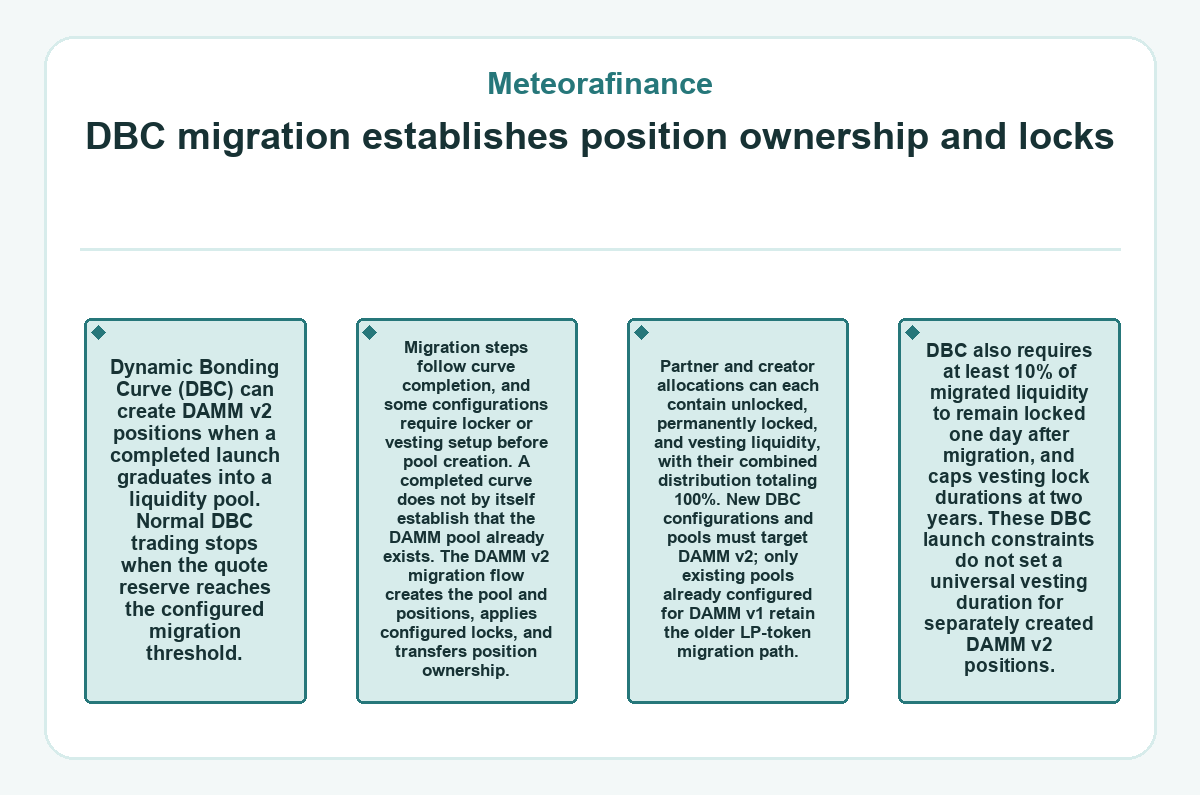
DBC migration establishes position ownership and locks
Dynamic Bonding Curve (DBC) can create DAMM v2 positions when a completed launch graduates into a liquidity pool. Normal DBC trading stops when the quote reserve reaches the configured migration threshold. Migration steps follow curve completion, and some configurations require locker or vesting setup before pool creation. A completed curve does not by itself establish that the DAMM pool already exists.
The DAMM v2 migration flow creates the pool and positions, applies configured locks, and transfers position ownership. Partner and creator allocations can each contain unlocked, permanently locked, and vesting liquidity, with their combined distribution totaling 100%. New DBC configurations and pools must target DAMM v2; only existing pools already configured for DAMM v1 retain the older LP-token migration path. DBC also requires at least 10% of migrated liquidity to remain locked one day after migration, and caps vesting lock durations at two years. These DBC launch constraints do not set a universal vesting duration for separately created DAMM v2 positions.
When can a DAMM v2 position close?
A DAMM v2 position can close only when total liquidity, pending token A and token B fees, and pending rewards all equal zero. Removing liquidity alone is insufficient while a fee or reward balance remains.
Closing the position burns its NFT and closes the NFT token account, NFT mint, and position account. An ownership transfer leaves the position in existence, while closure removes its ownership handle after the account meets the empty-state requirements.
Vesting liquidity remains part of total liquidity until it unlocks and the owner removes it. A position with a nonzero permanent bucket cannot reach the required zero-liquidity state through an ordinary withdrawal, because that liquidity cannot be withdrawn.
Good to know
What metadata does a DAMM v2 position NFT use?
The default metadata name is Meteora Position NFT, and the default symbol is MPN. These identify the position NFT rather than either trading token in the pool. The DAMM v2 program creates these NFTs under Token 2022 with zero decimals and a supply of one.
Who holds the freeze, mint, and update authorities for a DAMM v2 position NFT?
The DAMM v2 pool is the freeze authority for its position NFTs. The pool authority holds the mint and update authority. These program-level authority settings are separate from the NFT holder’s control over the associated liquidity position.
Can a position receive another inner vesting lock while one is active?
A DAMM v2 position cannot receive a new inner vesting lock while it already has active inner vesting. The position account stores the inner vesting schedule.
Are all LP fees automatically reinvested in compounding mode?
DAMM v2 compounding mode reinvests a configurable share of LP fees into pool reserves. The remaining LP fees stay claimable by positions. This mode collects fees in token B; a configured 100% compounding share leaves no LP fees claimable.
How many reward tokens can a DAMM v2 pool distribute?
A DAMM v2 pool supports up to two liquidity mining reward tokens. Positions track pending rewards in separate slots. This limit describes reward capacity within one pool, while actual accrual depends on its configured reward campaigns.
Do DAMM v2 positions require a separate farm for built-in mining rewards?
DAMM v2 provides liquidity mining inside its pool program without requiring a separate farming contract. Configured campaigns accrue rewards to positions based on their share of total pool liquidity. This differs from legacy arrangements that stake DAMM v1 LP tokens in external farming programs.
Does a token badge ensure that active transfer hooks work during liquidity withdrawals?
A token badge does not ensure that a DAMM v2 liquidity withdrawal can execute an active transfer hook. DAMM v2 token transfers do not forward the extra accounts that active hooks may require. Such mints can encounter transfer failures during liquidity changes or fee claims, even with a badge.
Can a DAMM v2 compounding position use a narrow price range?
A DAMM v2 compounding pool uses full-range constant-product liquidity. A fixed concentrated range belongs to the alternative liquidity model. Vesting and permanent locks govern the owner’s ability to remove liquidity; they do not define the pool’s trading price range.